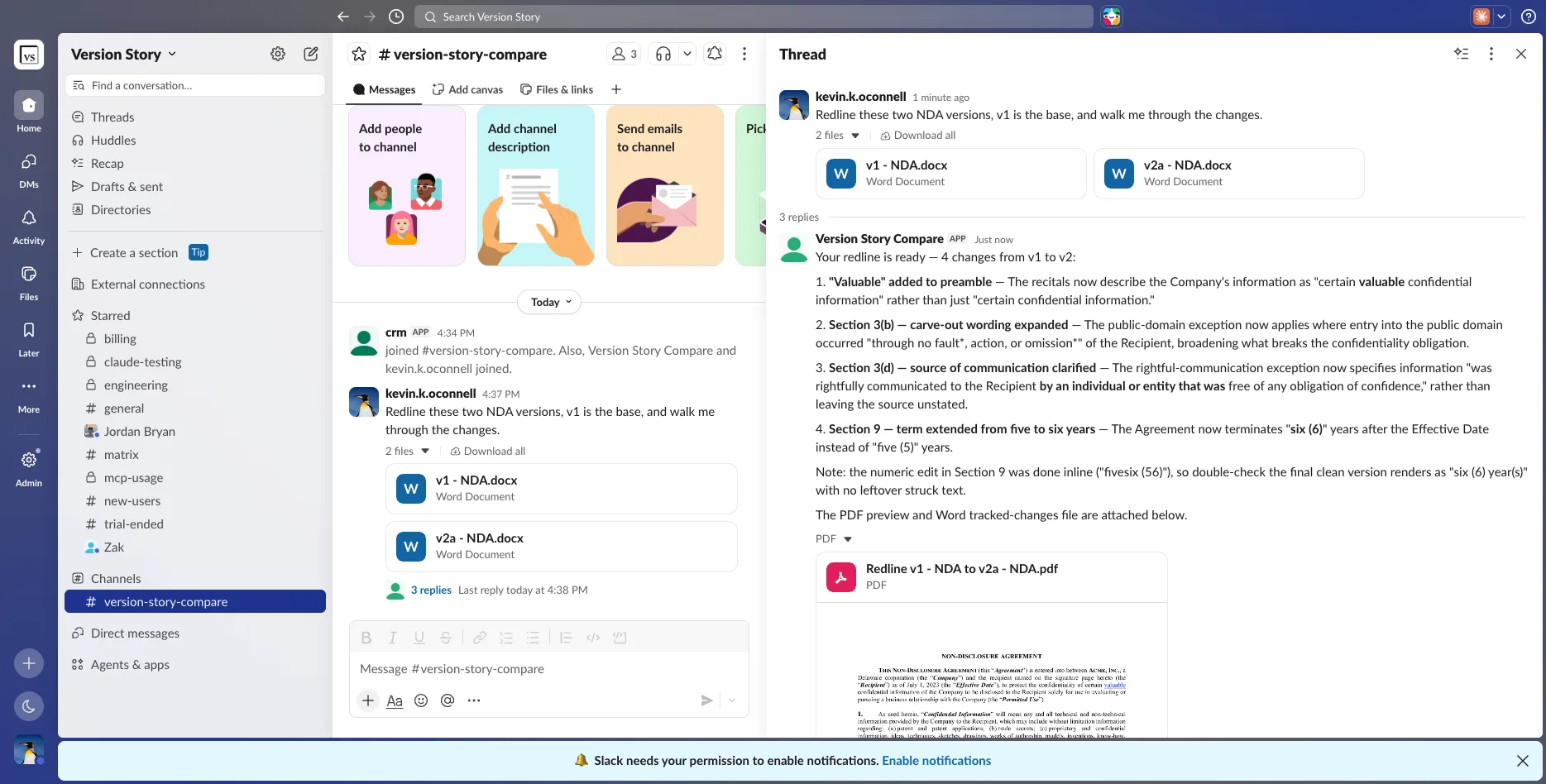
This guide connects the Slack agent your team already runs to Version Story, so a request like "redline these two versions" returns a true tracked-changes redline — the PDF previewed in the thread, the Word file beside it.
You will need:
- A Slack agent your team operates (see the requirements below)
- A Version Story account (an organization admin for Part 1)
- An agent framework with MCP client support
Agent requirements
Slack scopes. Your bot's Slack token needs:
channels:history— read the messages it responds to (addgroups:history/im:historyfor private channels or DMs)chat:write— post repliesfiles:write— upload the finished redlines
MCP client support. Your framework needs to connect to a remote MCP server over HTTP, with OAuth handled by the framework (every major MCP SDK and agent framework with MCP support does both).
Slack file context in the conversation. Attached files' url_private
links and the event's team_id need to reach the model conversation. A bot
that strips attachments down to message text cannot request comparisons.
Access to tool results. The bot needs to read the tool results inside each model response, not just the model's reply text — the redline download links only appear there, and the bot uploads those files into the thread itself (Version Story cannot post into your workspace). Frameworks that surface only the model's final text cannot satisfy this.
Version Story sign-in. The account the agent signs in as (Part 2) needs to belong to the organization that connects the workspace (Part 1), and the auth state your framework saves at sign-in needs to persist wherever the agent runs.
Part 1 — Connect Version Story to your workspace
This lets Version Story download the private files your team attaches in Slack, so your agent never has to download or re-upload documents itself.
- In Version Story, your organization admin opens
Organization Settings → Slack Integration → Connect Slack Workspace and
approves the install. The Version Story app requests one scope,
files:read; it receives no messages and posts nothing. - Invite it to each channel whose files it should access —
/invite @Version Story. It can only see files in channels it has been added to.
Part 2 — Connect your agent to Version Story
Your agent calls Version Story's MCP server as a Version Story user; every comparison it creates is saved in that user's projects.
-
Choose the account the agent will act as. Create (or pick) a Version Story user in the same organization that connected Slack in Part 1. A dedicated account (for example
agent@yourfirm.com) keeps agent-created projects separate from your team's own. -
Add the server to your framework's MCP configuration:
https://mcp-compare.versionstory.com/mcpThe server uses standard MCP OAuth. When your framework prompts for authorization, sign in in the browser as the account from step 1. Your framework stores and refreshes the credentials from then on.
That's the whole integration: the comparison workflow itself is defined by the server's tools and followed by the model, and your bot's two responsibilities — passing message context in, uploading the finished files — are the requirements at the top of this guide.
Troubleshooting
- File-access error on a comparison — the Version Story app is missing from that channel; invite it.
- Reconnect-required error — the workspace connection was revoked; an admin reconnects it in Version Story (Part 1).
Test it
With the agent running, post two versions of a document in the channel and ask for a redline. Within about a minute the thread should show the redline PDF previewed inline and the Word tracked-changes file below it. Reply in the thread as a second test — the bot should answer in the same conversation.